Thursday, August 18, 2011

"My Fellow American"

Note: A version of this article was first posted on the Foreign Policy Blogs Network on 23rd July, 2011 and can be found here.

On Wednesday, the a federal jury awarded $20,000 to a Muslim woman suing Abercrombie & Fitch (A&F) for refusing a Muslim woman a job based on her choice to wear the Muslim headscarf. More than the news article, the comments on it interested me.

Various readers said that the lady claiming against A&F, Ms. Samantha Elauf, knew that what kind of brand A&F was, what they were promoting, and referred to their ads as “racy” and “showing a lot of skin”, which should be unacceptable to a “practicing Muslim”. Although an interesting point, I have a few problems with this statement:

As an outsider, the reader is not in his right to state what is, in fact, recommended or approved behavior of a “practicing Muslim” just as much as a Muslim cannot comment on acceptable Christian/Jewish/etc. behavior. Forget an outsider; any Muslim does not have the right to judge or command certain behavior of another Muslim. But these misconceptions are our own creation – as Muslims we have allowed ourselves to dictate “Muslim behavioral norms”. We have seen countries order their citizens behind a veil (see: Iran, Afghanistan, etc.), which has made other nations order them out from behind it (see: France).

All this is because we have found it within our right, as Muslims, to tell each other what to do when it comes to dressing a certain way or behaving a certain way. This is not a debate of what is generally morally abhorrent, such as lying, stealing, killing, etc. but when we begin to dictate a certain preconceived general rule of what a Muslim or a Jew should wear or say, we take away the foundation of belief: free will.

The violence that is now commonplace in Pakistan is a result of liberties taken in dictating expected behavior. “Islamist Extremist ” (although I have an issue with that phrase) political parties have pushed their agenda in curbing the rights and movement of women in Pakistan, while advocating all this in the garb of religion.

All this is not to say that it is correct for A&F to have turned Ms. Elauf away based on her religious dress – an official condemnation of such discrimination must be made, and was made, by the federal court; but we must also see and acknowledge the flipside of the argument. A&F are entitled to promote a certain look just as much as Ms. Elauf is entitled to promote her religious belief.

The group “My Fellow American” is aptly advocating that Muslims are as much a part of the fabric of American society as anyone else and that they are allowed the same rights (including employment). Stories such as the one of Ms. Elauf remind us that Muslims are a part of America and ought to remind us that to respect the other side of the story and understand where they’re coming from as well. My Fellow American is looking for other such stories that remind us, as Mitch Albom put it, “You’re not a wave, you’re part of the ocean.”

Wednesday, May 18, 2011

When “lawn” was just the front yard

Once upon a time, the only occasion I heard the word “lawn” was when my Mother yelled her location to me in the late afternoons as she was gardening and sipping her tea. Now, it is what you wear when you brush shoulders with your fellow tea-sippers, God-forbid any gardening be involved.

I read this article once that mapped the digression of society by the way language evolved. The word “innit” had for long been used as slang and was never acceptable in formal – say, Scrabble – diction; in the same way “lawn” now symbolizes one outfit in your wardrobe that costs, oh, just minimum wage in our country. I have yet to sit through a conversation this spring/summer that doesn’t involve the question of how many new “lawn-joras” I got made and better yet, “whose” lawn I bought – because its not who wears it but who designed it, of course.

For my friends that don’t know what this is (never admit this loudly), it is basically soft, lightweight cloth that we use in our super-hot summers because it breathes easy and because it used to previously be affordable. The character of such material is such that after it is washed, say half a dozen times, it stretches out and fades into something that could only be used as a rag cloth; which would be fine if it cost bare minimum like lawn did back in the day. Now, you spend up to Rs. 6,000 (which is incidentally, minimum wage in Pakistan – which is usually what is paid to our daily workers in factories; domestic help is paid less) on an outfit that you will find several others wearing (in a different color if you’re lucky) real time. The upside: you instantly recognize which designer created this (generic) “work of art”.

Recently, I went to pick my mother up from one of her monthly luncheons. A room full of about sixty women, where I could spot the same outfit on at least 6 of them. That was just one outfit. The others were similarly replicated. Everyone looked like a blurry remnant of the next and, in the words of a classic “Eventually, all things merge into one, and a river runs through it.” A river of jealousy.

Here I was thinking what I wore defined who I was and made me stand out from the rest – but I guess I want to be like everyone else just so I can prove I spent way too much on this one outfit. How rich must I be? All this in a country where 24% live below the poverty line. Great!

When I admit that I have not bought any “lawn this season” because I don’t like lawn generally, I am looked at strangely with an eye that says “sure, you cheap bastard.” Maybe I am cheap. Maybe I don’t like wearing something that is printed in a manner that it makes me feel like bed linen, or maybe, just maybe, I’d rather spend that money on a vacation. I’m not saying I’m more charitable than Ms. Lawn, but I’m saying that I’d rather spend that money on something more durable.

Someone said that the money I spend on food (approximately 60% of my paycheck) is money, quite literally, down the toilet. I think the same about your outfit that makes you look like just another Smurf.

Potato-potato-perspective.

Tuesday, April 12, 2011

Veiled Questions

Note: A version of this article was first posted on the Foreign Policy Blogs Network on 13th April, 2011 and can be found here.

France houses over 65 million people – 5 million of whom are reported to be Muslim. Of these 5 million, only 2,000 wear a full face veil. In a country of 65 million, legislation that is targeted at 2,000; is this behavior not reminiscent of school-yard-bullying?

Islam is the second largest religion in the country but another study showed that within the next 10 years, most Europeans will not associate themselves with any organized religion. That being said, “second largest” implies a majority of some kind; and democracy teaches us what?

Although the niqab, or face-veil, is not unanimously agreed upon amongst Muslim scholars; for instance, a member of the clerics at Al-Azhar in Cairo (one of the most reputed Islamic Schools), has said there is no place for the full face veil in the Shari’ah; it remains still, a cultural norm amongst most that choose to wear it.

Be it a right claimed in the name of religion, or a cultural practice, the fact of the matter is that Muslim women, are the only ones that wear a niqab. Their right to cover their faces falls clearly under Article 4(2) of the Declaration On The Elimination Of All Forms Of Intolerance And Of Discrimination Based On Religion Or Belief, 1981; thereby making signatory states (France included) duty bound to enforce.

People have argued that the legislation, although seemingly aimed at emphasizing the secular standing of France, is more of a political play to gain support. We’ve seen religion being used as a tool for popular support in most countries, many of which consider themselves Muslim nations (e.g. Pakistan); but we have also seen that such discrimination has only further fueled personal prejudices and intolerance.

In the meantime, two niqab-wearing-protesters were arrested outside the Notre Dame in Paris on Monday – apparently because they were part of an “unauthorized demonstration” and not because of their veils. It is reported over a dozen people gathered there – but only the two wearing a veil were arrested. Is this not harassment?

The law itself is a bag of confusion: people who force women to don a veil are subject to up to a year in prison and a $43,000 fine and possibly twice that if the veiled person is a minor. But what if the woman wants to wear it herself? In an attempt to garb the targeted law as something applying to all faiths [see also: Frances ban on “religious symbols” in the classroom 2004 – which basically only hurt women wearing a Muslim head-cover or, Hijab], it also bans people from wearing masks or full balaclavas, except during fetes, artistic performances or sports events – so just Muslims women, Darth Vader and thieves posing as skiers are generally not allowed to walk the streets of France. But if Darth or the thief is riding a motorbike, they too are exempt. Basically, it’s just Muslim women or others who constantly don a veil. So, just Muslim women.

The way I understand “secularism” and “democracy” was that the state itself would not prescribe to a particular religion – but that it would also not discriminate against its citizens for choosing one and freely practicing it. This ban, if nothing else, goes against these concepts. Insolent much, Sarkozy?

Wednesday, March 16, 2011

A Play on Words

Dr. Firdous Ashiq Awan, Minister of Information, has said that the release of Davis was in accordance with the Shariah. Now, she could’ve just said “the law of Pakistan” since we’re so certain that it is in line with the injunctions of Islam (it is not), and let it be. But to shut up the multitudes who are mesmerized by the mere mention of the word “Shariah” – making the act done unquestionable and undeniably just, she (as many before her) did a quick play on words and lay the issue to rest.


What she did not tell us was what happened to the other accounts he was charged with. What about the fact that he did not have a valid visa to be in Pakistan (for which the Lahore High Court had placed him on the Exit Control List – and which only the same court can take him off of). But let’s not discuss these other very important issues.


Besides, Clinton seems to be positive the US did not pay the Diyyat and I’m almost certain that Davis could not afford that hefty a sum on his own. So, what in fact did happen and why is the Government resorting to the old disgusting blame game that leaves Islam as the only thing to be questioned, therefore, unquestioned?


In other news today, the Minister of State for Religious Affairs has been dubbed by the Supreme Court to have taken part in the “Hajj Scam”. Since we’re talking about rhetoric, that’s the worst sentence I’ve read in a while.

Monday, March 14, 2011

The Truth Behind Blasphemy

Note: A version of this article was first posted on the Foreign Policy Blogs Network on 5th March, 2011 and can be found here.

“You are free; you are free to go to your temples, you are free to go to your mosques or to any other place or worship in this State of Pakistan. You may belong to any religion or caste or creed that has nothing to do with the business of the State.” – Muhammad Ali Jinnah, Founding Father of Pakistan: August 11, 1947.

July 5th, 1977: Pakistan saw the advent of a new Head of State. Not elected, Muhammad Zia-ul-Haq was the second Chief of Army Staff to overthrow the government in a bloodless coup d’état within the first thirty years of Pakistan’s inception – escorting in an age of “Islamization,” contrary to everything Jinnah had propagated. In attempts to rally support, Zia used the oldest trick in the book – religion as a tool to gain popular support; contaminating the true essence of religion.

Zia’s claim to fame is the introduction of the “Shariah” (literally meaning “the way” – interpreted as Islamic Jurisprudence) into the legal system of Pakistan through the Hadood Ordinance. [An Ordinance, passed by executive order lacks Parliamentary approval.] Under these broad rules, Zia sought to “Islamize” Pakistan by introducing laws on adultery, fornication, slander and blasphemy, amongst others. Under these same laws, he curtailed the rights and liberties of a minority sect, the Ahmedi’s, restricting their movement and shunning them to somewhat of a class of untouchables [Note: Islam has no tolerance for distinguishing between class and creed].

Although we could talk about each of these laws and how they are specifically against the injunctions of Islam (which the Federal Shariat Court – a court that has the power to question and amend laws to bring them in line with Islam – ought to have shot down at first instance), and how protests and years of struggle have enabled Pakistani’s to finally amend some [See: Protection of Women (Criminal Laws Amendment) Act, 2006], a pressing issue today are the blasphemy laws.

These laws have been incorporated into Pakistan’s criminal legislation through Section 295 of the Criminal Code. Section 295 of the Pakistan Criminal Code forbids damaging or defiling a place of worship or a sacred object [Note: the place of worship is not defined as a mosque]; 295-A forbids outraging religious feelings [Note: religion not specified]; 295-B forbids defiling the Qur’an and 295-C forbids defaming the Prophet. Except for Section 295-C (defaming the Prophet), the provisions of 295 require that an offence be committed with intent (which is a tough burden of proof to dispel). Defaming Prophet Muhammad merits death with or without a fine, with or without intent.

It is 295-C under which most egregious acts are committed. Before, it was a power game where Muslims in a village would accuse a Christian of defaming the Prophet or defiling the Qur’an, sending him to prison and leaving his property up for grabs. Now, a false sense of Muslim pride has been aroused with concerns to the honor of the Prophet. We saw this take an ugly turn with the Danish cartoons in 2005 and now, in Pakistan, the call to amend the Blasphemy laws has claimed the lives of two government officials, Governor of Punjab, Salman Taseer and Minister of Minorities, Shahbaz Bhatti. [Please note: such acts have burdened Pakistani soil since time immemorial; it is only recently when it has moved into the political circle, agitating the international media.]

The problem is the misconception that “blasphemy” is a crime punishable by the state under the Shariah. Time and again we’ve seen Muslim clerics, “mullah’s” come on various talk-shows in Pakistan, quoting the Qur’an, proving that slandering the Prophet and his honor is punishable by death. One such cleric quoted, quite fluently, verses 56-58 and then 61 of Surah (chapter) Ahzab (number 33); strategically missing out two verses which clearly change the topic of discussion.

Islam, the word, means submission; submission to God. The God who in the Qur’an gives you the right to take revenge when you have been wronged, but then adds “The recompense for an evil is an evil like thereof, but whoever forgives and makes reconciliation, his reward is due form Allah. Verily, He likes not the oppressors.” (42:20 – The Qur’an). Looking closely, cohorts of the blasphemy laws say that they are protecting the honor of the Prophet.

The other side of the story is that the Prophet, himself, never took such measures to protect the same honor. When he was yelled at, he turned away; when someone accused him, he patiently listened. There’s a famous story about an old lady that would throw trash out of her window on him every day. One day she didn’t and concerned, the Prophet went to her house to check if she was okay. If he was to avenge his honor, he would’ve done it then, or God would’ve said something about it in the Qur’an – but it wasn’t. The Prophet was taught not to judge people, because that was God’s job. He was taught to humbly invite people to Islam and never give up, because you never know when someone may have a change of heart.

It goes against all injunctions of Islam to punish people for a belief dissimilar to your own, much less to met out the death penalty. Time and again God asks Muslims to be patient, to respect your neighbor, protect him and if you find yourself in company that is talking ill of your religion, your beliefs, leave their company and only return when they speak of other matters [See The Qur'an 2:104 and 6:68].

It is this misconception and misinterpretation, rather adulteration, of the Qur’an by its clerics that has led masses to believe blasphemy ought to be punishable by death. It is these people, that go unchecked by the government, much less punished, that are able to turn Pakistan into a hate-mongering nation it has become today.

So, as another day passes, another is buried for expressing his views; views which are far more well-founded than those of the perpetrators that set him in his final resting place. And what of the government? The President of Pakistan did not attend the funeral procession or call the family of the deceased for condolences – supposedly fearing for his life.

A Radical Debate

Note: A version of this was first posted on the Foreign Policy Blogs Network on 10 March, 2011 and can be found here.

There is a fine line between freedom of expression and obnoxious behavior; which may very well be crossed in the coming weeks in Congress.That said, as a Muslim and as an American – I support the debate.

As upset as we were to witness residents of Orange County yelling obnoxious slurs at Muslims gathering for a fundraiser; it was just as much the constitutional right of Yorba Linda and her colleagues as was the right of hundreds that gathered in Times Square this past weekend to proclaim that “today, I am a Muslim too.” One of the above incidents leaves a sour taste in my mouth, as a Muslim; the other may do the same for Rep. Pete King and his supporters. But democracy has never been about individual tastes.

The “Radicalization of Muslim Americans” hearing that kicks off in Congress today may be walking the wire of political correctness, but the reality of the situation is that it should be inspiring people. The calm with which Rep. King and Rep. Ellison discuss their opposing views and their objectives of attending the debates is the lesson to be learned. Ellison, as the first Muslim to be elected to Congress, is reminding us what the Prophet of Islam taught; patience and tolerance. When asked why he was participating in this debate, Rep. Ellison eloquently said; “Because I believe in engaging the process. I think you got to be involved in the conversation. You got to offer an alternative view. And I do plan on saying that I challenge the basic premise of the hearings. That I do agree that we should deal with radicalization and violent radicalization, but singling out one community is the wrong thing to do.”

We can debate how we do not believe the “experts” being used in this hearing are actually experts or how people are saying that Rep. King is “exploiting ethnic misunderstanding (rather) than in trying to heal it” – as long as it is a discussion and not a declaration.

Reports tell us how unpopular King is, even within the ranks of his own party. Again, that is their perspective. I think we can take solace in the fact that a healthy deliberation shall ensue, and pray that nothing accusatory towards one belief system comes of this. But we must stand by the constitutional, and God given, right of everyone to hold their own opinions.

“My Lord, give me the capability to tolerate an opposing point of view. My Lord, keep me wise and aware, so that I may not judge someone or some idea right or wrong unless I have understood him/her or it correctly and completely.” – Dr. Ali Shariati

Saturday, February 12, 2011

Gone - Jack Johnson

"Look at all those fancy clothes,
But these could keep us warm just like those.
And what about your soul? Is it cold?
Is it straight from the mold, and ready to be sold?
...
And what about your mind? Does it shine?
Are there things that concern you, more than your time?
...
Gone, people, all awkward with their things, Gone."

Tuesday, November 2, 2010

Flood Relief - October 31, 2010

Halloween morning, 2010, Val, Farah and I woke up super early and pulled on our "costumes" and head out for Pir Sabaq, District Nowshera, Khyber Pakhtunkhwa, Pakistan. Said to be one of the worst hit areas in the country, where “worst” is relative considering all including family and livelihood is lost. Being hit at all is life changing; for the three of us, not hit, it was life changing - so what these people have seen or been through is unfathomable.


We left Islamabad at 7:30 a.m. this Sunday morning to drive approximately an hour and a half to Nowshera (literally translated: "New City") in the KPK region. There we met with Sadiq, our helper from Mardan. Stories of the people affected are essential, but it is equally essential to tell the story of people like Sadiq. He's a government employee, works five days a week in Islamabad and travels back to Mardan (two hours from Islamabad if you travel by car - public transport takes longer) to be with his family. He makes at least two trips a week to Pir Sabaq, a village on the outskirts of Nowshera where we were aiding in the rebuilding of a couple of homes. Sadiq is not an affluent man; barely middle class, he asks of no rewards and is helping people in a village outside of his neighboring city. With no vested interests in the project, this man was here on a Sunday morning, missing out on his family lunch, to show us around the village and accompany us in surveying the work done and pointing out what needed to be done.


With Sadiq on board, we drove through Nowshera. We saw Internally Displaced camp-sites peppered around the city; in schools, colleges, roadsides, basically anywhere they could find enough room to set up a group of tents. We visited, what the locals call, "College Camp" set up in the local boys college. The government set up this camp when the floods initially hit (we later learn that in fact it took them a couple of weeks to set this up) and since, the government - or anyone else for that matter - had not revisited these people with food or money or supplies to help rebuild their homes. The camp was set up when the college was closed for summer break. It has since opened and is functioning at full capacity – minus a soccer field which now houses some fifty tents housing at least four or five to a tent.


Inside the camp we met with a mother of 12; her eldest 15 and youngest 3; a widow, who had to distribute her children amongst relatives because they were getting sick in the camp, sans food for days. We were told that people in this camp would often purchase goods from local stores on credit; credit they didn't know how they'd repay, or if they could. Another old lady started shouting loudly and pointing towards Val, scaring her just slightly. The lady wasn't upset that we had a foreign female accompanying us; she was upset that she had nothing and was looking to Val to help her [something made me wonder why the lady complained to Val, the obviously foreign female, and not to Farah and myself].
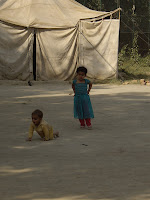


Yet still, there was a man in the camp that insisted I help his mother rebuild her home. When asked why he couldn't help his mother, he said that what he earned barely proved enough for his family, consisting of his two children and his wife. When I saw his wife I suggested he let her work somewhere part time to help out in the house, to which he laughed and responded "Bibi, hum Pathan hain!" ("Ma'am, we are Pashtun"). Apparently that translates into not letting their women earn a livelihood. He had no trouble asking another woman (me) to help out, but his woman - God forbid! When he asked me to photograph his wife, I responded similarly "Nahin bhai, aap Pathan hain!" ("No brother, you are a Pashtun"); I wouldn't dream of dishonoring his wife so.

Shame.


We distributed candy to the children, who all too eagerly held out their hands. I shook their hands, in an attempt to dissuade them from the attitude of begging or pleading, spoke to them (in a language they didn't understand) and then handed them the candy when I thought they were no longer expecting it (I dream). This is what scares me - the hapless attitude adopted by those who have fallen on bad times. There will always be those people that will be all too happy to play the victim and have things fall in their lap. But they are victims; at least right now. How do we turn that frown upside-down and inspire them to go out and seek sustainability again, in a place where nothing seems to be going right and the government’s attitude is only making it that much harder.


When we headed out of College Camp, we drove through the outskirts of Nowshera city and into Pir Sabaq. Driving through the village, just down from River Kabul (the fountain that overflew to cause this state of affairs), we saw sites where houses once stood, various crop fields awaiting their next rotation and many other fields with standing water, now covered in a mossy-gooey substan

ce [note to self: must google technical term]. Yet, there were fields that were harvested with the next rotation and seemingly working well. There were few "houses" that had more than two walls. None had a roof. As we drove further into town, we saw shops and villagers in the market, bustling about their business as usual. A couple of the shops had repainted and many lay shut - possibly on account of it was a Sunday, but we were told that some just didn't have the money to reinvest and reopen.


We pulled into the local boys school where the Lion's Club had set up a Medical Camp for the day. Because my friends carried heavy filming equipment, instantly everyone got up their defenses and didn't want (or wanted, we don't quite know) media there. But we assured them, as did the village elder and our liaison for the place - Baqi Billa - that we were simply there to take a look at where our donations had been used. The "Head Master" of the school showed us around all the rooms, now painted and brightly reflecting the glaring sunlight. Then he showed us into a room that he had not fixed up, as a reminder of how Mother Nature had left the place.


We saw the remnants of school records [unless you could now pull something out of the records of the Ministry of Education, let’s just say - chances of you applying to college are few and far between] and library books. Sports supplies had dilapidated and lay in a pile at the back, with fragments of left-over tinsel that probably decorated classrooms. A chair hung on the wall near the door; it was elevated to that point by the water and now just rested on some rusty old nails. You could see watermarks on the walls, close to the ceiling and books hanging by the fans. Farah and Val said the site reminded them of what they saw of New Orleans after Katrina.


Across the street from the school was the local Mosque. Inside, the quarters for the Imam were completely destroyed, but the rest of the Mosque had been restored to a more usable state - whitewashed and new prayer rugs provided and a new water pump was being installed. A heavy log of wood, practically a trunk of a small tree, had been washed here by the power of the floodwater and now rested on the tin roof of one of sections of the Mosque. We were dumbfounded, imagining how terrifying such a force must have been, coupled with the helplessness that comes with a natural disaster that strikes with such urgency.


Moving around in the village, from house to house - or what remained or didn't remain thereof - we saw the adversity of the affects of the flood. There were some who were very blessed and had the entirety of their homes standing, looking slightly grey, but standing nonetheless. One such family called us into their home to show us cracks in their ceiling (directly on top of their refrigerator and television set) and pleading to fix it because they could not afford the same; all the while their neighbor's house was now a pile of rubble. I don't know whether to label that "ungrateful" or sheer "self-centric".


There were homes with one wall standing, some with three and so me with nothing. People had moved out of their "houses" to live with family and friends around the village or in a tent, balanced on the rubble that lay where once their home stood. The most unfortunate had to resort to living in a camp, just outside the village. What we saw amongst the people of Pir Sabaq was a bond - each spoke to the next like one speaks to family. Baqi Billa told us that when people brought vehicles and boats to pull people out of the village to dry land, they didn't come in search for their loved ones; they took who they found and paddled them to a village slightly elevated on a nearby mountain. Baqi showed me the electrical cables that ran on poles above the homes and said "we floated our boats above those cables". I'm not even going to get into how dangerous that possibly was.


We visited the two homes that have been reconstructed with your donations. One belonged to a lady that was not home because it was her daughter’s wedding in the neighboring village; she would now live here with her frail husband, who was disabled and could now not work. The second home belonged to a widow - who, when we went to visit, was herself visiting the Medical Camp at the boy’s school we saw on our way in. We managed to catch up with her later and she showered us with prayers and appreciation.


We also met with two other women whose homes we were beginning work on. One is a widow, mother of three; two of her three are drug addicts and the third is mentally unstable. She, definitely pushing her mid-sixties at this point, provided for the three of them. The second lady was a widow who lived alone and helped with her brother’s family and his work. He could not provide for her himself because he could barely provide for his nine children. Nine. Another brother of theirs had twelve.


We sat down with Baqi Billa and his family to talk of the work they had undertaken in the village - about how everyone gave so generously of themselves for the benefit of their neighbors. We were astounded at how selfless most of these people were. Their hospitality is unprecedented; when we couldn't eat the fruit offered to us at Baqi's home, they bagged it for our ride home.


After our interview with Baqi, his sister-in-law came to visit and we were able to sit her down for a talk. She had previously worked as a Lady Health Worker with the government. [These are the people that go door to door to educate women on family planning.] This lady was very eloquent and highly educated. She did her Masters in Islamic Studies from a local university after she got married. She was the mother of two daughters, the youngest of whom was accompanying her today’ the eldest was at medical school in a nearby city. When I asked her if she'd educate her daughter on family planning before she got married, she shied away; "she'll learn on her own - I can't tell her things like that." Confused, I asked whether she considered it apt to be friends with your children, as I was with my mother. "I'm friends with my daughter, but we can't talk about such things. And I know she won't ask anyone else. She's sensible like that." This nonsensical sensibility would miraculously ensure that these girls know about family planning and ensure her health and that of her children. Miracles happen every day.


That said, it was refreshing meeting someone so educated and someone whose husband promoted her education. I just wish they'd break these cultural idiosyncrasies while they were at it. She did tell us that women used contraceptives without their husbands knowing because they would not approve. They told us that many were tired of not having enough to feed their existing children and continuing to have more. Still, the average family in this village alone must consist of 5-8 children.


One battle at a time, I guess.


Thursday, May 20, 2010

When in doubt - blame South Park

It "hurts our religious feelings" when people talk smack about our Prophet. Not that I knew I had religious feelings that were distinct from... well, just "feelings". Mostly, I liked how one news article spoke of the "monster" that created the Facebook page that invites the world at large to draw cartoons of the Prophet. That is what brought the Lahore High Court to tears and made them pass the order to restrict that page, then the whole of Facebook (because it is innately the work of Lucifer himself), and then of course, Youtube (possibly because too many people were checking out the new Shakira video).

To enlighten my friends that were wondering why I haven't posted seventy news articles to my Facebook wall since the morning, I shared with some a news article explaining the ban on Facebook and the lawsuit that began it all. Felipe called
this news piece the most "awesomely badly written news article". (We don't have a problem coming off as idiots at all.) There's a legal premise behind all this. Under the Prevention of Electronic Crimes, 2007 - Section 29 and 30, Zuckerburg and his entire team could be fined a grand total of *drum roll* $2,300! Yes sir, that and they could be made to serve a sentence of up to two years. Territorial boundaries, you say? Pft - if Facebook is far-reaching, so are the arms of justice of Pakistan (inspired by the Bollywood "Kanoon key haath bohot lambey hotay hain, Judge Sahab" dialogue, of course).

So, all day Thursday my friends and I exchanged notes on what else has been banned by the Pakistan Telecommunications Authority (certain Wikipedia pages are also inaccessible) - and when our internet slowed down or just died, as it often does, we were all too quick to jump to conclusions of the PTA restricting everything. We love spreading rumors.

In the words of the cartoonist Nikahang Kowsar, "I believe we have the right to offend, but when offense is seen as an 'insult', it might be a bad time to draw an offensive cartoon." Agreed. Its a stupid idea to rile up the "religious emotions" of a certain group, but equally silly is the fact that we got so riled. Hina said "Its gone too far." She's one of my friends that said she wanted to boycott Facebook for that one day that the cartooning contest was being held. Agreeing that it was silly, she insisted that she'd rather do something about it peacefully than do nothing.


But how far is too far? Is it not "far" enough that we're wanting to block that page alone from Facebook, which translated into blocking all of Facebook and then Youtube? CNN analysts said that the reason Youtube was blocked was as a "preemptive" measure - people will make videos of the contest and of the cartoon's they've created and post them to Youtube, the Pakistani government, although not saying it out loud, was trying to preempt just that. Youtube is just one of the pages our government deems "sacrilege". Thankfully, the Wikipedia page defining the word has not blocked - yet (although numerous others have been) and I was able to look it up. It says "injurious treatment of a sacred object".


Muslims believe that faith begins from within and that though we believe in God, unseen, He is out there and watching us and protecting us and testing us. Similarly, although we haven't seen the Prophet, we believe in him and follow his teachings. What object, again, is it that these people are treating injuriously? I thought the whole concept of Islam was not to objectify that which we revere? I'm a little confused.


Personally, I'm a little relieved that I'm not compelled to update my status on Facebook in search for affirmation. So, I can be "enjoying my cup a joe" without having to tell the world about it - and it really will taste just as good. I don't know how we got so pulled into this. I was suffering withdrawal from incessantly posting news articles to my wall, but now I just spam my friends' inboxes. I know most of my friends are doing okay without Facebook - even those whose life and job depend on their Mafia Wars scores. But then we have various student bodies carrying out rallies and chanting "Death to Facebook!" I really wish we'd come up with a new slogan already.


And to think, all this of a South Park episode.

Monday, May 17, 2010

Sinister Sarcasm


This was a picture sent to me in one of those forwards; the ones that frantically spread like the proverbial wildfire we all hate. The minute I saw it I knew it was doctored, but then something inside me wanted to make sure. It's pretty obvious that this could not be real; that the ACLU would be all over it if it were, but, something was still very unsettling about this image. I, like any other schmuck, forwarded this to a bunch of my friends - those people you know won't judge you stupid for sending this out and will tell you what they think of it; while not letting their own political/ideological beliefs be fanatically dethroned.

Farooq, endowed with the super-abilities to articulate his unadulterated thoughts on politics and policies said: "
I'm also positive it's doctored, but its still very sinister. And by sinister, I mean the effect the creators are going for is definitely achieved. It's smart of them not to pick some seedy, shady, scruffy looking desi. They pick a fairly harmless looking guy and, by doing so, encourage you to question the intentions of people falling OUTSIDE the stereotype of potentially dangerous Muslims. Check out the way he is looking at you in the poster. Taken by itself, it'd just be a regular boring picture. But armed with all the rhetoric underneath, its capable of being a little creepy. Its basically shouting out 'trust no one'."


Naiara, with her undying patience and incessant requirement to be politically correct said (after assuring me that she, as a frequent MTA user, knew this to be a fake): "
One possible explanation is that someone might have designed it with the objective of drawing attention to the potential racial profiling interpretation that the original ad might have on certain prong minds (the original add says: "if you see something, say something" and has the picture of an abandoned item under the metro seat). It can even be the case that someone has been the victim of racial profiling based on the ad, but I have never read or heard of it happening."


I think that this forward was a little bit of both; sinister yet sarcastic. In a time like this when something as meaningless as a cartoon sketch or a South Park episode can get us frazzled (not that I think such frazzlement is warranted), someone thought it in their malicious right to create and spread something like this. Mind you, desi's are innately stupid so we'll buy this junk at first sight. I just hope it doesn't get in the hands of someone like Zaid Hamid (or maybe his zombie-esque minions are the ones that created it) so that they can use it to accent their beliefs that the world is out to get them. "Them": not just Muslims, but Pakistani-Muslims because they're the worst kind.

It could also be something intended to be sarcastic pun at the way brown-folk in general are being treated (considering that most Pakistani's are now being driven to claim Indian heritage, uf, sacrilege). Either way, its uncalled for because it's messing with my head. I was left there thinking "maybe?" and I've got plenty else to be thinking about right now. It just goes to show the sad state of affairs of the world at large (and the lack of caffeine in my system at that hour), when we'll believe (or at least question/ponder, if even for an instant) the legitimacy of something as absurd as this. I question my intelligence before I do anyone else, but it just leaves me thinking, if I could for a second be "doubeyew-tee-eff" about this, could someone, not educated and unaware of civil liberties and their importance in the Land of the Free, not take this to be real?

Sigh. What have we come to?

"I run to the Rock, please hide me..."

Thursday, May 6, 2010

"You know what's amazing?"

Felipe messaged me yesterday and asked me just that. "The moon today looks exactly like the earth does in the famous picture taken from teh moon of the earth-rise. Quite amazing..."

It reminded me what someone once said, or maybe I read it somewhere. Warning: it could very well have been a sappy chick-flick. They said that the moon is the same, you might look at it at different times and from different angles, but its the same moon, world-over. Felipe once said that it gives him peace knowing that we're all connected in some way.

I miss you, Dude.

This is one of his masterpieces (therefore copyrighted to him - I just took liberties).


Friday, April 9, 2010

Petty Scandals

This past weekend I attended a conference at the Lahore University of Management Sciences which had panelists flown in from Europe, America and India, carefully iced with the best Pakistan had to offer. I found that there is no dearth of intellectually brilliant minds in Pakistan; the dearth lies in our knowledge of their existence and appreciation for the work they do. I’ll be the first to shamefully admit that I had heard of only a few of our local attendee’s, and that too by word of mouth. I’d never taken the time out to look into the work they were doing or gauge what it was they were trying to tell us. Doctor Phil says that admitting the problem is the first step to recovery.


Take Strings for example, until they were jamming with John Abraham and Sanjay Dutt, we didn’t really give a dhaani. We all know the tale of how we found Ustad Nusrat Fateh Ali Khan astounding once India started begging him to sing for Bollywood. That’s when we started noticing what the likes of Peter Gabriel and other maestro’s of the West had noticed decades before (also, the West loved him for his Qawali’s – long before his soundtrack to Dead Man Walking). Then, we all heard the tale of how Ustad Nusrat’s grave was dug up and his body was found enveloped in his own tongue. Why? Blasphemy, of course - he used the same tongue to sing songs for the Hindu’s that he once used to praise Allah. Astaghfar. I mean, none of us use our namazi tongue’s to curse at the beggar who dared touch my clean car window that I zapped up as he approached. Never. My grave will be sound and my body shall not be shroud in my tongue, but in light - nur; Alhumdulillah.


The appreciation our local hero’s (including academics) receive and the acknowledgement their work and contribution to Pakistani culture and heritage is given is negligible, to say in the least. Instead, it is the likes of Shoaib Malik that are recognized, not for their “confused-cricketeering” (in the words of a world-renowned cricket blogger), but for marrying someone from behind enemy lines. That seemed to be all I could find on the news this week. As much as I wanted to escape it, I could only find information of the weight problems faced by Shoaib’s first wife (Note to World: nikkah’s conducted over the phone are so passé) and how Sania Mirza really doesn’t like wearing short skirts – they’re just practical. I couldn’t find any coverage of the attack on the U.S. embassy in Peshawar or the general state of affairs in the world, post Obama’s speech to change the U.S.’s attitude towards use of nuclear arms; all that is secondary to the love affair that shall be settled in a nikkah in Dubai, where Shoaib’s family can incidentally fly with more ease.


Hina said to me that it was refreshing, seeing Shoaib battle with the media over his personal life. She said it was refreshing because it “takes our mind off of the explosions and all the lives we’ve lost”. However, instead of distracting ourselves with educational information concerning the majestic character that was our Quaid (as opposed to the run of the mill, boilerplate description we find in our Pak-Studies books), we’d rather watch the latest Michael Moore documentary on how the U.S. is full of sicko’s. “It’s cooler”; just as it was once cool to smoke, then it wasn’t and now it’s cool again. Frankly, I’m losing count.


What Hina said next is what caught me off-guard and made me think. She said that India has prospered because they revere their culture, promote it, and endorse their leaders and figureheads; “Gandhi is god”. I’m not saying Gandhi was not all that they say he was; he was indeed, a brilliant man, but so was Allama Iqbal and Ajmal Khattak. My friend eloquently concluded: “in our country the going-rate for buying respect is a couple of million Rupees, not good deeds.” Sadly, she’s right; we promote the wrong people. Sure Meera Jee has contributed to her share of cinema and whether or not I think she’s good is secondary (I don’t). But that we’re so fascinated about what email address it was that she used to write to her purported husband in impeccable diction, is what leaves me dumbfounded.


Indian artist, Bhai Baldeep Singh, calls it involvement in “petty scandals”. We’re too involved in how one of our own would take a bride from the other side of the border, to notice that about 40 children get kidnapped each week from villages and remote areas we cannot drive our newly polished convertible’s to. Reports of these kidnappings will never hit the airwaves like Sahil Saeed’s kidnapping did because these children do not speak the Angraizi and their parents make minimum wage – barely. Mr. Singh says that we’re too engrossed in religious and geographical preferences to notice our real issues and try to resolve them. I believe that we need a break from the constant flow of bad news; but our media personnel should be looking to fill that void with good inspirational stories, not a bad remix of Star Plus and old-wives-tales.


After listening to all those intellectuals talk of how India and Pakistan, although partitioned, shared much of the same problems and had much of the same soul, I wonder if they’re right. Clearly, India seems to be going places we’re only beginning to learn of. I don’t think our partition with India is remotely related to our plight; it’s our partition from our own culture, our own people and their achievements and accomplishments that require more consideration. Just like we’ll come out in flock to see what Sana Safinaz has in store for this year’s lawn season, let’s see what the likes of Kamal Khan Mumtaz, Ayesha Jalal and Tariq Rahman have to say, generally.